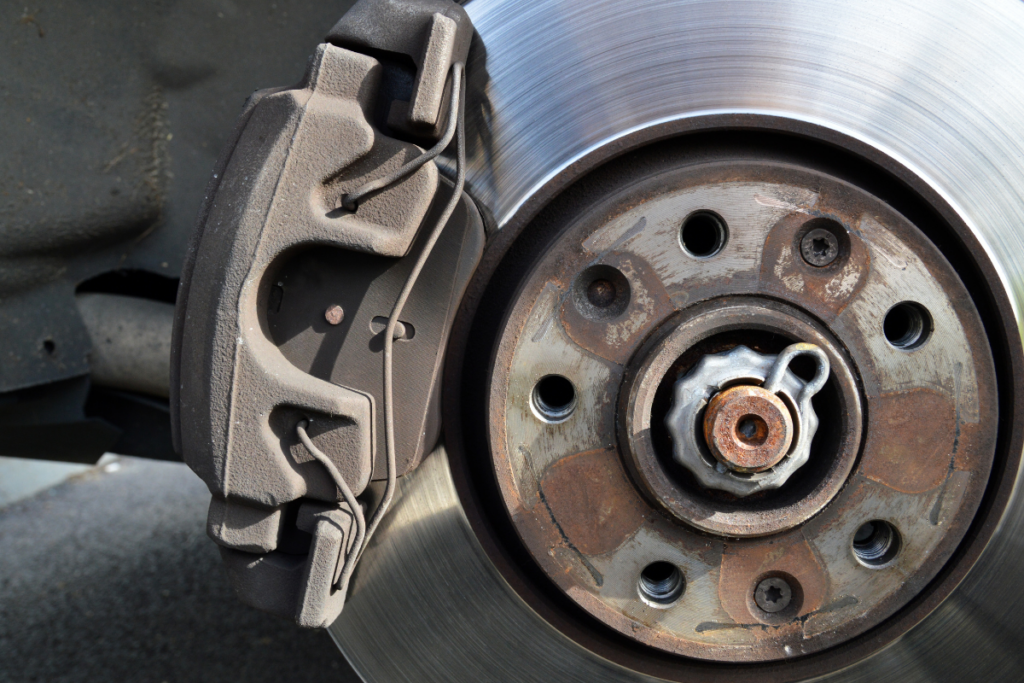
It really doesn’t have to be said, but we’ll say it anyway: braking systems are perhaps the most critical aspect of safe automobile operation.
Although the concept of braking is quite simple, you apply pressure to the brake pedal, and the car slows until it stops, the mechanics behind the system are quite complex, especially given how often we use our brakes every day. That’s why braking system parts and components have three non-negotiable fabrication requirements that must be adhered to with every new build:
- Material integrity must remain consistent under repeated thermal expansion and contraction
- Dimensional accuracy must hold across high-volume production runs
- Surface finishes must support friction performance while resisting premature wear
Optimal Material Selection
Material behavior plays a key role in selecting which metal or specialty alloy will work best for the part’s role in the braking system.
For example, grey cast iron offers excellent thermal damping, making it the preferred choice for rotors that are subject to heat stress. Aluminum alloys are often used for calipers as they combine exceptional strength with light weight. Pins and brackets require the wear resistance that hardened steels can deliver.
Material selection also informs variables within the fabrication process, such as tooling strategy, cutting speeds, and coolant application. By developing the appropriate fabrication strategies early in the process, fabricators can avoid inconsistencies and deformations during downstream processing.
Maintaining Dimensional Accuracy
Meeting tolerance stack-up requirements is critical in brake components. Any deviations from tolerance specifications can lead to hydraulic inefficiency, unwanted vibration and noise, and poor performance throughout the braking assembly.
Precision machining with CNC technology, combined with strict process control, delivers accurate, high-quality results by enabling fabricators to optimize toolpaths and use advanced metrological techniques that ensure that tolerance requirements are met with precision.
Real-time quality control within the machining process ensures that any deviations are caught early, creating a closed-loop system that prevents deviations from reaching post-fabrication processing and delaying production.
Surface Treatments That Maintain Integrity
Another critical aspect of brake system fabrication is the use of finishing techniques to ensure reliable performance. This necessitates treating the part’s surface characteristics to prevent corrosion and withstand high levels of thermal stress and friction, right down to the microscopic level.
For example, brake rotors require surfaces that withstand sustained friction while minimizing noise and wear. If the surface is too rough, the system will experience accelerated degradation and potential vibration issues. Conversely, a surface that’s too smooth will impact braking efficiency. Fabricators can mitigate these risks with precision grinding, which refines the surface profile beyond what standard machining can achieve.
Many brake components rely on heat treatment, such as annealing, quenching, or tempering, to achieve the mechanical properties required for reliable wear resistance and structural integrity. Comprehensive testing after heat treatment validates the part for further processing.
Read More: How Heat Treatment Enhances Product Quality, Strength And Performance
Scaling Without Compromising Fabrication Quality
Automotive OEMs rarely order vehicle components in small batches. That’s why their fabrication partners need to maintain consistent precision for high-volume production runs.
However, OEMs need to be cautious about working with facilities whose best credential is capacity. Having a large production floor space is an important first qualifier, but they also prioritize standardizing material selection, fabrication, and validation processes to minimize variability in the final product.
Integrated automated fabrication technology also contributes to quality, especially when these advanced systems enhance repeatability and efficiency without compromising the ability to monitor and control critical parameters.
To achieve their production goals, OEMs must partner with precision machine suppliers capable of meeting their exact requirements. At Kenona Industries/Arrow Automotive, we provide the perfect fit.
Read More: Reshaping The Metalworking Industry With Sustainable Material Sourcing
Arrow Automotive: Your Premier Choice for High-Quality Precision Machine Solutions
With over 35 years of expertise in providing high-volume machined components that enhance the efficiency, reliability, and safety of gas-powered and electric vehicles, Kenona Industries/Arrow Automotive is your only stop for quality metal fabrication solutions.
We use highly skilled, qualified technicians and automated precision machining technology to fabricate and assemble high-quality automotive parts and components for leading OEM and Tier 1, 2, and 3 suppliers. Our team prioritizes delivering exceptional customer service and tailored solutions that cut lead times, optimize your production scheduling, and save on manufacturing costs, all without compromising on your quality expectations.
When you’re ready to start building, call our team first!
Contact Kenona Industries for a quote on your next design and fabrication project
Kenona Industries is a world-class supplier of automotive components to leading OEMs and Tier 1, 2, and 3 manufacturers. Discover what sets us apart by requesting a quote for your next project today